Frequently Asked Questions
Answers to common questions about Manoomin, MWRI's work, how to get involved, and how to participate respectfully.
Questions About Manoomin
Manoomin is an aquatic wild grain (Zizania palustris) that grows in the shallow lakes, rivers, and wetlands of the Great Lakes region. It is not the same as the commercially cultivated "wild rice" sold in grocery stores, which is typically grown in California or in paddy systems and is a different variety or species altogether.
For Anishinaabe peoples — Ojibwe, Odawa, and Bodéwadmi nations — Manoomin is far more than a food crop. They are a relative, a teacher, and a gift central to Anishinaabe identity, ceremonies, and understanding of place. MWRI uses "they/them" pronouns for Manoomin to reflect that Anishinaabe relationship.
Manoomin historically grew throughout Michigan's Upper Peninsula and northern Lower Peninsula — in hundreds of lakes, rivers, and wetland systems. Today, viable beds persist in many of these locations, though distribution and density have declined significantly due to pollution, invasive species, hydrological alteration, and development pressures.
MWRI follows Anishinaabe usage in referring to Manoomin as a relative rather than a resource — a living being with agency, not a commodity to be managed. Using "they/them" is one small linguistic marker of that relationship: it signals that Manoomin is not an "it," not a thing, but a relative deserving of care and respect.
This language is intentional and consistent throughout all MWRI documents and communications. For more on this choice, see the Manoomin–Anishinaabe Relationship Guide.
Most "wild rice" sold commercially is not Manoomin. It is typically Zizania palustris grown in paddy systems in California or Canada, cultivated through methods that bear no relationship to traditional Anishinaabe harvest. Some products labeled "wild rice" use entirely different species.
Authentic hand-harvested Manoomin from Michigan lakes and rivers is available through Tribal enterprises and community harvesters. Supporting these sources directly benefits the communities that have stewarded Manoomin across generations.
MWRI is a collaborative, Tribally-led initiative working to restore and protect Manoomin across Michigan. It brings together the five federally-recognized Anishinaabe nations in Michigan alongside state and federal agencies, universities, and other organizations in a shared stewardship framework.
MWRI is not a state agency program or a nonprofit — it is a collaboration governed by the Anishinaabe nations whose ancestors have maintained relationships with Manoomin since time immemorial. Learn about our governance structure →
MWRI is guided by a Steering Committee that includes delegates from the five federally-recognized Anishinaabe nations in Michigan — Bay Mills Indian Community, Keweenaw Bay Indian Community, Lac Vieux Desert Band of Lake Superior Chippewa, Little River Band of Ottawa Indians, and Sault Ste. Marie Tribe of Chippewa Indians — along with representatives from the Inter-Tribal Council of Michigan.
Three subcommittees carry out the work: Education & Outreach, Policy & Protection, and Monitoring & Restoration. Each subcommittee includes Tribal natural resource staff, state and federal partners, and invited technical advisors.
MWRI's work is supported through a combination of tribal government contributions, federal and state agency partnerships, and competitive grants from environmental and cultural conservation funders. MWRI does not solicit public donations. Partner organizations contribute in-kind through staff time, data sharing, and technical support.
There are many ways to support Manoomin depending on your role, location, and relationship:
If you're a landowner or lakeshore resident: protect riparian buffers, avoid pesticide and fertilizer runoff into waterways, and contact your local Tribal natural resource department before undertaking any shoreline modifications.
If you're an educator: incorporate Manoomin into your curriculum using MWRI's free resources and Stewardship Guides, which include materials specifically designed for classroom use.
If you're a researcher or practitioner: reach out about partnership opportunities through the appropriate subcommittee. MWRI welcomes collaborative research proposals that are developed with rather than about Tribal nations.
Everyone: purchase authentic hand-harvested Manoomin from Tribal enterprises. Learn about Anishinaabe relationships with Manoomin through the resources on this site. Advocate for water quality protections in your watershed.
Manoomin harvest is a cultural practice governed by the Tribal nations and communities whose members have relationships with those waters. It is not a public activity that anyone can join without an invitation and relationship with the community.
MWRI periodically hosts community events — including educational ricing days — through its Education & Outreach subcommittee. These events provide a respectful context for learning. Check the event calendar for upcoming opportunities.
Non-Native individuals should not harvest from Manoomin beds without explicit authorization from the relevant Tribal nation, regardless of state fishing or harvesting regulations.
MWRI's Stewardship Guides are free to download and include materials appropriate for educational use. Guide 1 — on the Manoomin–Anishinaabe relationship — and Guide 3 — on working in a good way with Manoomin — are particularly useful in classroom contexts.
If you are developing curriculum materials that draw on MWRI content, we ask that you share drafts with our Education & Outreach subcommittee before publishing. This helps ensure cultural accuracy and alignment with how Tribal nations want their relationships with Manoomin represented. Contact us to discuss →
Manoomin typically ripens between late August and mid-September in Michigan, though timing varies by water body, latitude, and year-to-year weather conditions. Traditional ecological knowledge — accumulated over generations — is the most reliable guide for reading when a particular bed is ready.
Tribal nations set their own harvest seasons for waters within their jurisdiction. State-regulated waters also have harvest seasons set by EGLE and the DNR in coordination with Tribal resource managers. MWRI does not set harvest seasons.
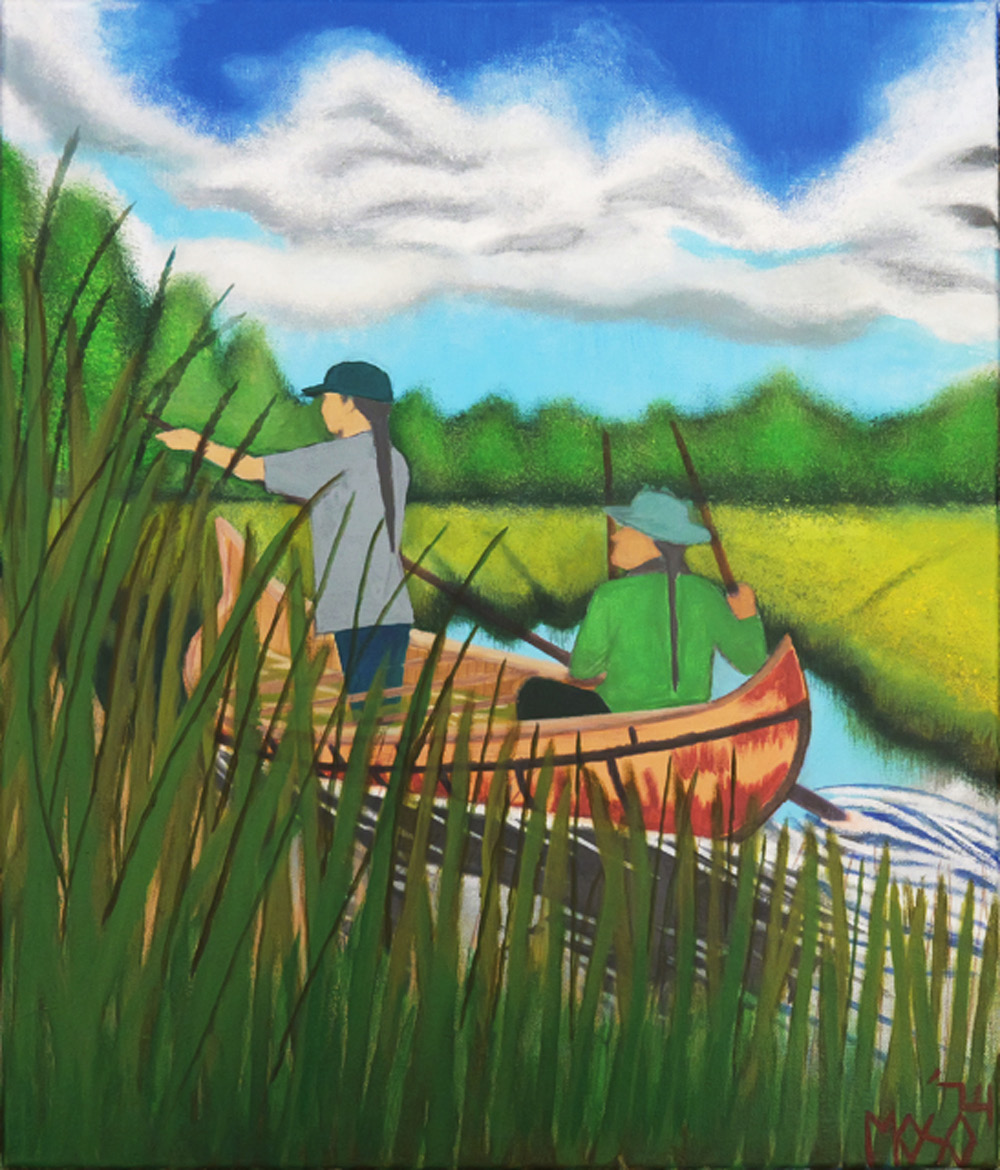
Traditional Manoomin harvest uses a canoe (often a flat-bottomed "rice boat") and two wooden knocking sticks — one to bend the stalks over the gunwale and one to knock the ripe grain into the boat. This method is gentle enough that it leaves a significant portion of grain in the water and on the plants, supporting wildlife and next year's crop.
Motorized harvesting equipment can cause serious damage to Manoomin beds and is prohibited in most jurisdictions. Even non-motorized equipment beyond traditional knocking sticks is subject to regulation and community consent.
Public Act 247 of 2023 designates Manoomin as the official native grain of Michigan — the first such designation for any U.S. state. The act was signed by Governor Whitmer in November 2023 after advocacy by MWRI, Tribal nations, and their partners.
While the designation is largely symbolic, it carries real cultural and political weight: it acknowledges Manoomin's significance to Michigan and to the Anishinaabe nations who have stewarded them across generations. MWRI sees it as a foundation for stronger protections. Learn more about MWRI's policy work →
Manoomin is protected through a patchwork of state environmental law, federal water quality standards, treaty rights, and Tribal regulations. Key protections include the Clean Water Act (which governs the water quality that Manoomin depends on), Michigan's natural resources and environmental protection laws, and the harvesting rights reserved through treaties between Tribal nations and the federal government.
Many Tribal nations also have their own Manoomin-specific protections on ceded territory and trust lands. MWRI's Policy & Protection subcommittee works to strengthen and coordinate these protections. Learn more about our policy work →
Manoomin face a range of interconnected threats:
Water quality degradation — nutrient loading from agricultural and urban runoff increases turbidity and algae growth, reducing the light that Manoomin seedlings need to establish.
Invasive species — particularly invasive carp (which devastate the shallow water habitat Manoomin depend on) and invasive plants like Phragmites, which can outcompete Manoomin in impacted wetlands.
Hydrological alteration — dams, drainage ditches, and shoreline hardening change the water level fluctuations that Manoomin's life cycle depends on.
Climate change — warmer winters, altered precipitation patterns, and more intense storms affect both the conditions Manoomin need to survive and the timing of their growth cycle.
Have a question not answered here?
We're happy to help. Use the contact form to reach MWRI directly and we'll respond within 5 business days.
Contact MWRI